Why the Future Lives at the Edge in 2026?

Edge computing is not a new idea. Processing data closer to where it is generated has been a direction in enterprise technology for years. What has changed in 2026 is not where AI lives - it is where AI works. AI is increasingly moving beyond centralised infrastructure & closer to where data is generated, decisions are made & physical actions take place. When AI operates at the edge, everything about what an edge device needs to be, how it needs to be built & what it needs to sustain over its operational lifetime changes fundamentally.
Several technology shifts have now made edge AI increasingly practical at enterprise scale. AI-capable silicon - neural processing units integrated into SoCs from Qualcomm, MediaTek & Apple have reached a price point that makes edge inference viable at device scale. AOSP-based industrial platforms have matured to the point where purpose-built enterprise devices can run sophisticated AI workloads locally. The global Edge AI market reflects this momentum: valued at approximately $30 billion in 2026 & projected to reach $118.7 billion by 2033, according to Grand View Research. For many organisations, edge AI has now moved beyond experimentation into production with measurable business outcomes.
What follows is not a prediction about where edge computing is heading. It is an account of where enterprise AI already is & here are five reasons why the most consequential computing happening right now is happening at the edge.
5 Reasons Why Edge AI Is Shaping the Future of Enterprise AI
1. Edge AI Reduces Latency for Real-Time Decision Making
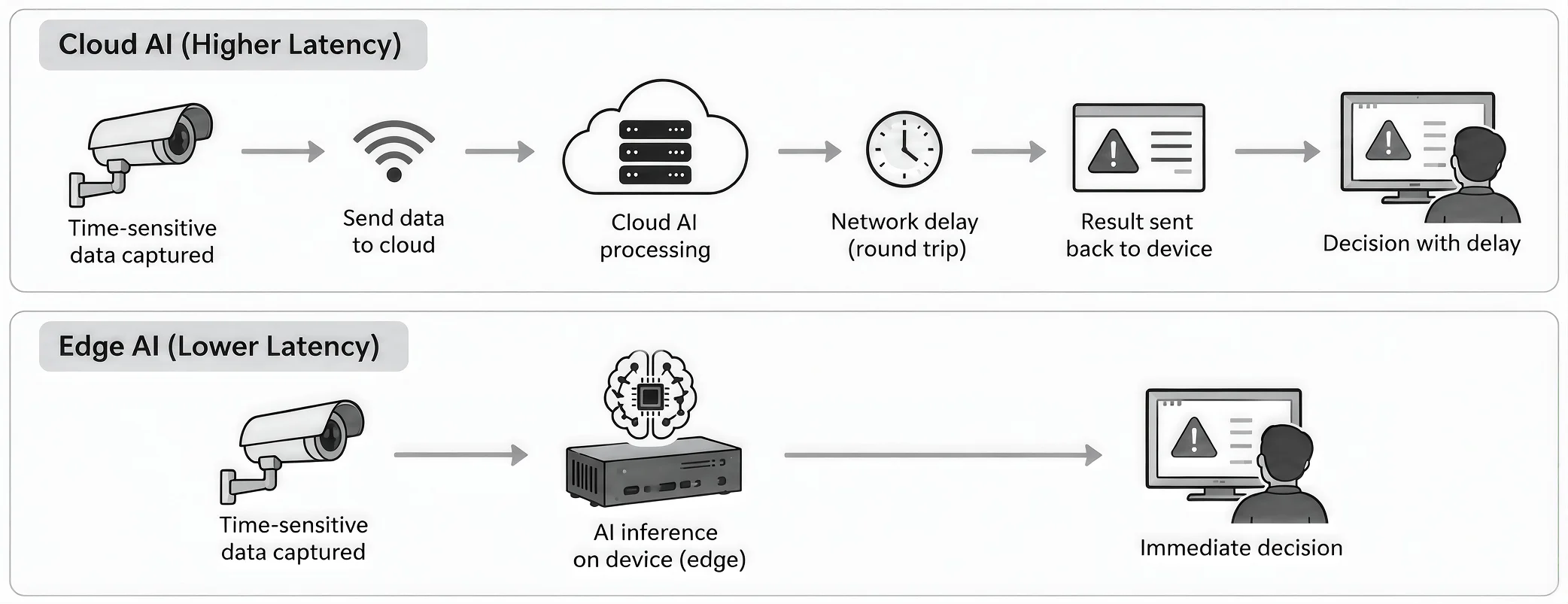
The assumption that cloud-based AI is sufficient for enterprise deployments holds in exactly one condition: when the time required to send data to a server, process it & receive a response does not affect the outcome. That condition is far less common than most technology strategies assume & the consequences of misidentifying it are not performance gaps. They are deployment failures.
A manufacturing assembly line inspecting components for defects operates under machine-cycle constraints that leave no room for network round trips. A warehouse robot navigating around moving human workers needs navigation decisions in real time. An autonomous vehicle making a lane correction cannot wait for a remote response. A surgical imaging system flagging an anomaly during a procedure operates in a context where even relatively small network delays can become unacceptable when the AI system is operating within a machine cycle or safety-critical workflow.
In each of these above environments, a cloud-dependent architecture may be structurally unsuitable for the use case - not because cloud AI is inadequate in general, but because the latency it introduces is incompatible with the operational requirement.
The organisations that recognised this early redesigned their AI architectures around local inference. Those that did not are discovering that latency is not a metric they can optimise around - it is a constraint that determines whether a deployment is viable at all. Edge AI does not simply improve response time in these contexts. In many of them, it is what makes the application possible.
Takeaway
Latency can determine whether the deployment is viable
2. Edge Computing Enables AI Without Reliable Connectivity
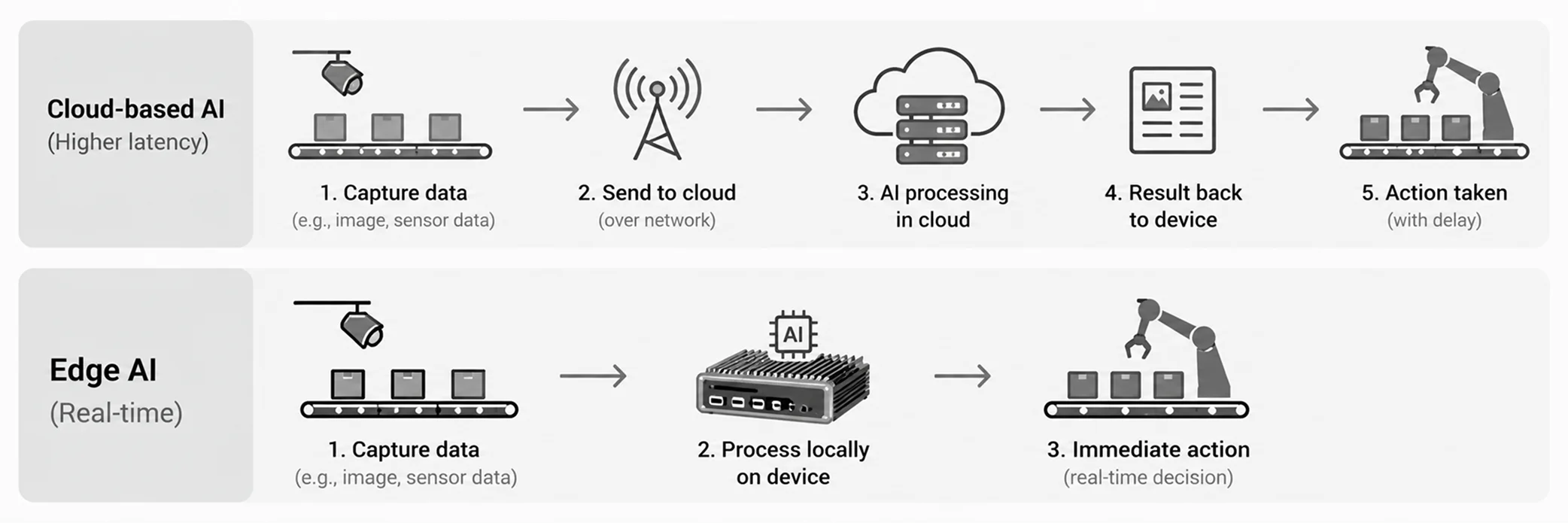
Enterprise deployments happen where the work is. The work is not always where the network is. A field technician servicing infrastructure in a remote location does not have guaranteed connectivity. A logistics vehicle moving through a tunnel or a loading dock with dense RF interference cannot depend on a reliable cloud connection. A device on a factory floor surrounded by heavy industrial machinery operates in an RF environment that consumer network assumptions were never designed to accommodate.
The standard response to connectivity uncertainty has been offline mode - a degraded experience that suspends certain functions until connectivity is restored. That is not a solution. It is a concession. Edge AI offers something structurally different: the device continues to make intelligent decisions regardless of network state, because the intelligence lives on the device & not in a remote server. Data is processed locally. Decisions are made locally. The network, when available is useful for synchronisation, model updates & fleet telemetry. But the device does not depend on it for the operations that matter.
Organisations that have built their operational workflows around cloud-dependent AI learn about their network dependency assumptions the first time the network fails at scale. Organisations that have built for edge-first operation discover that connectivity is a convenience, not a dependency. The difference in operational resilience between these two architectures compounds over time & the cost of the wrong choice accumulates quietly until it becomes impossible to ignore. The work is where the device is. The intelligence increasingly needs to be there too.
Takeaway
Connectivity should support the operation, not determine
whether it can continue.
3. Edge AI Strengthens Data Privacy & Data Sovereignty
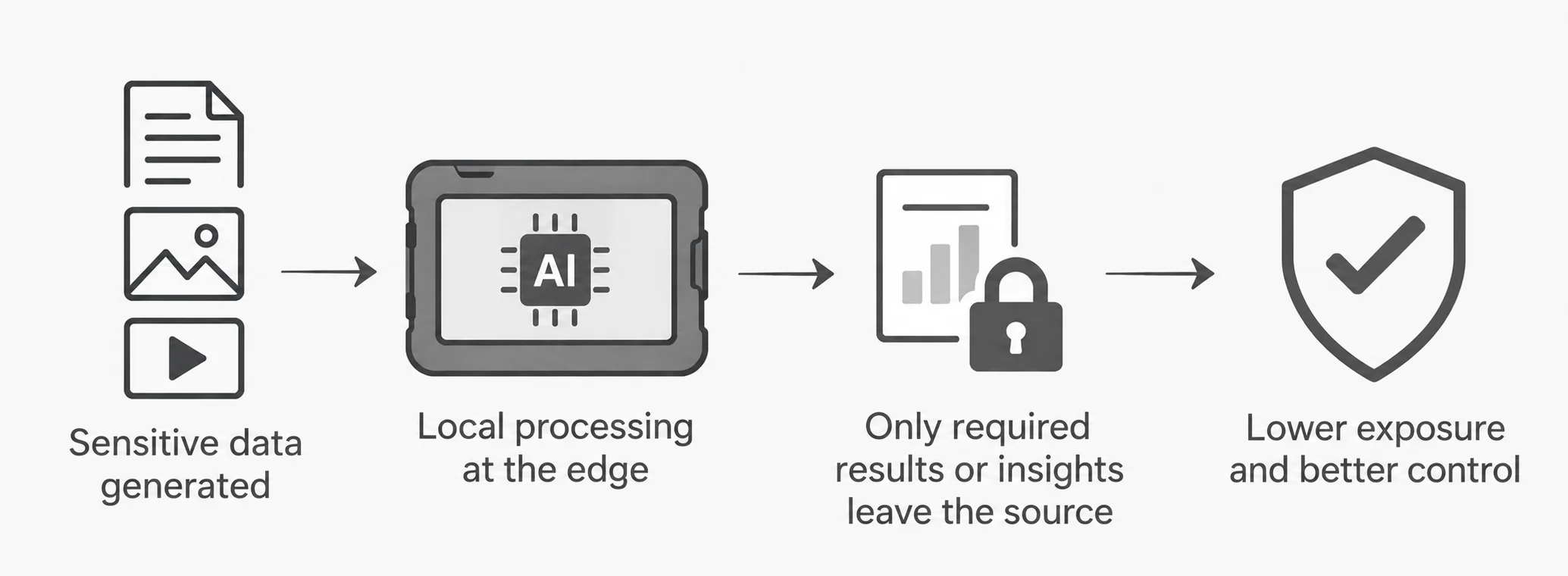
The regulatory environment around data has changed the way organisations think about where AI processing should happen. GDPR in Europe, HIPAA in US healthcare, the EU AI Act, India's DPDP Act & a growing body of national data localisation requirements all increase the importance of understanding where data is processed, stored, accessed & transferred. These are not abstract compliance considerations. They are architectural constraints that enterprise technology teams can no longer defer to a legal review at the end of a project.
Healthcare is the clearest example. Patient data generated by medical imaging devices, wearable monitoring systems & clinical decision support tools carries significant privacy & security requirements. Cloud-based AI that routes patient data to a remote server creates compliance exposure that many healthcare organisations are not willing to accept. In many cases, local processing can significantly reduce data movement & simplify the architecture needed to meet privacy & data-governance requirements without the data leaving the facility where it was generated.
The same principle applies in financial services, defence & national security, & industrial environments where operational data represents commercially sensitive intellectual property. Edge AI is not automatically a compliance solution, compliance depends on jurisdiction, data type, security controls & applicable regulation. But it can meaningfully simplify the compliance architecture by keeping certain processing activities closer to the source. The question for enterprise technology leaders is no longer only where data is stored. It is where intelligence should process it.
Takeaway
The question is no longer only where data is stored, but
where intelligence processes it
4. Edge AI Is Turning Devices Into Intelligent Platforms
For most of the past decade, enterprise devices were treated as endpoints - the last mile of a computing architecture whose real intelligence lived in centralised systems. The device captured data, displayed results & executed instructions from somewhere else. What differentiated one enterprise deployment from another was the application layer, not the device. The device itself was largely interchangeable.
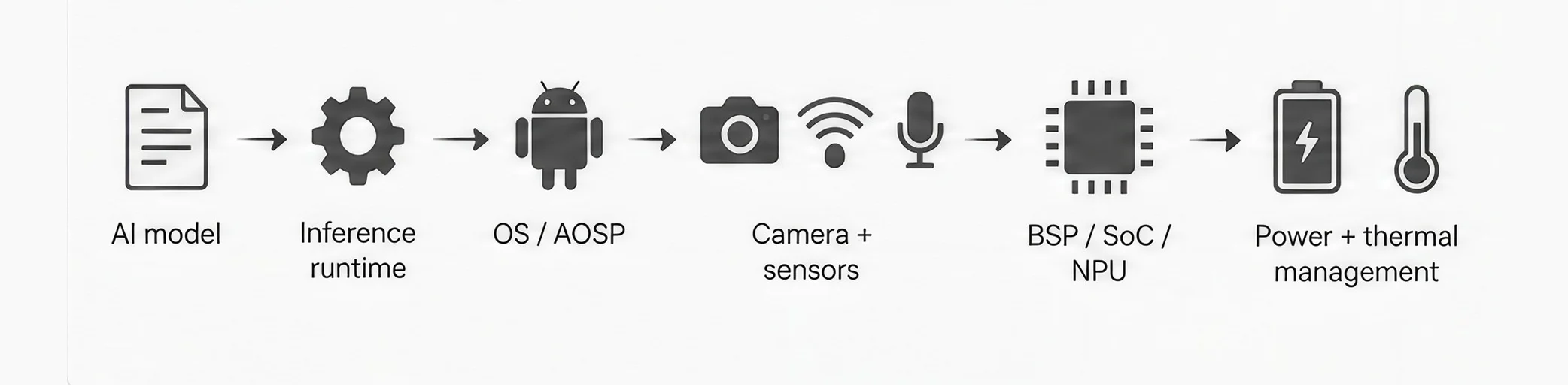
As AI moves to the edge, that model inverts. The hardware specification, the operating system configuration, the inference runtime, the power management architecture, the thermal envelope, the camera HAL, the sensor integration - all of these determine whether the AI running on the device performs as intended in the environment it was deployed into. A well-trained model running on a poorly specified device, with an unoptimised inference stack & a power management configuration not tuned for continuous AI workloads will not perform at the level the lab suggested it would. The device is no longer a passive host. It is an active determinant of AI performance & that changes the role of the device from endpoint to platform.
Organisations that understand this are approaching device engineering very differently from those that still treat hardware as a commodity. Custom AOSP platforms built for edge AI workloads with BSP-level optimisation for inference, camera & sensor HAL configurations tuned for specific data capture requirements & power management designed for continuous intelligent operation over extended operational shifts are delivering substantially different production outcomes than generic Android devices running the same models. The device is the platform. How it is engineered determines what the AI can do.
Takeaway
How the device is engineered determines what the AI can
actually do.
5. Edge AI Requires Operational Resilience & Lifecycle Management
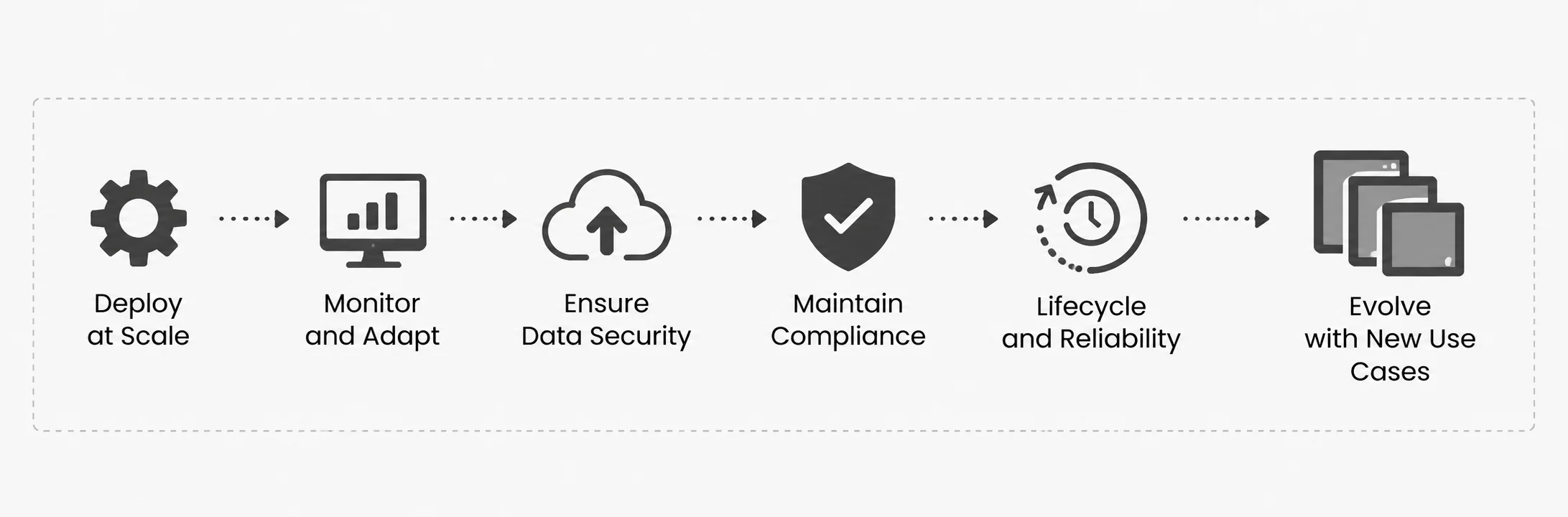
Every system that depends on external infrastructure inherits the failure modes of that infrastructure. A cloud-dependent AI deployment inherits dependencies on network connectivity, cloud availability & the integrity of the data pipeline connecting the device to the server. But operational resilience at enterprise scale is not only about what happens when the network goes down. It is about what happens to a fleet of intelligent devices over months & years of operation in demanding physical environments.
A production edge deployment has to answer questions that a pilot never surfaces: how is the model updated across hundreds of field devices without interrupting the operational process those devices support? How are security vulnerabilities patched on devices that cannot be taken offline? How are hardware configuration differences between production batches accounted for in validation & deployment? How is device health monitored remotely across a geographically distributed fleet? How does the system behave after two years of operation in a factory environment, a logistics vehicle, or a field service location? These are not laboratory questions. They are operational questions - & they determine whether an edge AI initiative remains a successful pilot or becomes a dependable enterprise system.
Edge-first architectures that are designed with lifecycle discipline from the outset - with OTA update infrastructure, remote monitoring, rollback capability & fleet management built in - absorb these challenges without disruption. Those that are not designed this way encounter them as emergencies. Operational resilience at the edge is not a feature that can be added after deployment. It is a structural property of the architecture & it has to be designed in from the first day of the program.
Takeaway
Operational resilience must be designed in from day one.
AI Models to Production-Ready Edge AI Systems
Organisations can already demonstrate that an AI model can run on an edge device. That is no longer the difficult part. The difficult part is deploying that capability across hundreds or thousands of devices & keeping it reliable – at the accuracy the pilot demonstrated, under the operating conditions the field environment presents, over an operational lifetime measured in years rather than weeks.
A Computer Vision model that performs well in a controlled test environment can experience significant degradation in production if the camera HAL is misconfigured, thermal constraints are not managed for sustained inference workloads, or the inference runtime has not been optimized for the target SoC. A model deployed to a device fleet can deliver inconsistent results if hardware variants - different production batches, different component revisions were not accounted for in validation.
Moving from a working model to a production-ready system therefore requires the inference runtime, hardware, sensors, operating system, power and thermal behavior to be engineered and validated together. The gap between a model that works & a system that works is a hardware-software engineering problem. It is the most consistently underestimated problem in edge AI deployment & the one that determines whether a pilot becomes a production system or remains a proof of concept that never scales.
How UnfoldLabs Enables Production-Ready Edge AI
The edge AI opportunity described in this article ultimately has to work on devices – in the environments where enterprise work actually happens: factory floors, hospital wards, warehouse aisles, field service locations & logistics vehicles. Building those devices correctly – in a way that makes edge AI reliable, not just possible - is the engineering problem UnfoldLabs is built to solve. Simply put, Edge AI brings intelligence onto the device; UnfoldLabs engineers the device platform that enables that intelligence to work reliably in production.
Our work sits at the hardware-software integration layer of custom AOSP platforms: BSP development & kernel bring-up for the specific SoC the device runs on, camera & sensor HAL configuration for the data capture requirements of the AI workload, inference runtime optimisation for the compute budget & thermal envelope of the device, power management tuned for sustained intelligent operation rather than intermittent consumer use, & OTA update infrastructure that delivers model updates to a fleet of field devices without disrupting the operational process those devices support. These are systems engineering problems - not application development problems & they are the ones that determine whether an edge AI deployment performs in production the way it performed on a bench.
The organisations getting edge AI right in 2026 are not necessarily the ones with the most advanced models. They are the ones that built the device infrastructure to run those models reliably - at scale, over time, in the environments where their operations depend on them. That is the engineering problem UnfoldLabs exists to solve.
My Thoughts
What I observe in the organisations navigating edge AI well is a consistent pattern - they stopped treating the device as a commodity & started treating it as infrastructure. They understood that the gap between a model that works in a demonstration & a system that works in production is an engineering problem at the device level & they invested in solving it before deploying at scale, not after. That decision – to treat the device seriously, to engineer it deliberately, to own it over its operational lifetime – is what separates the organisations that are capturing value from edge AI from those that are still explaining why the pilot didn't scale.
The edge is not where all computing is going. Training, large-model inference, centralised analytics & enterprise orchestration will continue to rely on cloud infrastructure – & rightly so. But the decisions that determine operational outcomes in the physical world – in factories, hospitals, warehouses, vehicles & field environments – are increasingly being made at the edge. & the quality of those decisions depends not on which model was chosen, but on the engineering discipline that brought that model into the real world & kept it performing there.
“The future of AI will be shaped not by intelligence alone, but by our ability to make that intelligence work reliably in the real world. “
– Asokan Ashok,
CEO, UnfoldLabs Inc.